
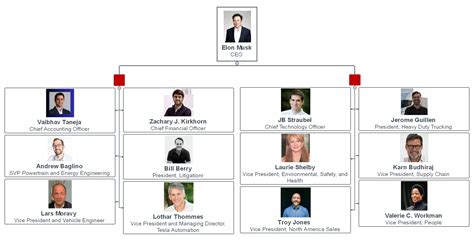
Tesla, Inc., one of the world's leading electric vehicle (EV) manufacturers and clean energy companies, has been shrouded in mystery regarding its organizational structure. However, through various reports, interviews, and regulatory filings, a comprehensive picture of the company's internal dynamics has begun to emerge. As of 2022, Tesla's organizational structure is characterized by a relatively flat hierarchy, with a strong emphasis on innovation, sustainability, and technological advancement.
Overview of Tesla’s Organizational Structure

Tesla’s organizational structure is designed to facilitate rapid decision-making, innovation, and collaboration across different departments. The company is led by its CEO, Elon Musk, who plays a crucial role in shaping the company’s strategic direction. Tesla’s leadership team includes several key executives, each responsible for overseeing various aspects of the business, such as product development, manufacturing, sales, and energy products.
Key Components of Tesla’s Organizational Structure
Tesla’s organizational structure consists of several key components, including:
- Product Development Team: responsible for designing and developing new products, such as electric vehicles, battery systems, and solar panels.
- Manufacturing Team: oversees the production of Tesla’s products, including electric vehicles, battery packs, and energy storage systems.
- Sales and Marketing Team: focuses on promoting and selling Tesla’s products, including electric vehicles, energy storage systems, and solar panels.
- Energy Products Team: develops and deploys Tesla’s energy-related products, such as solar panels, solar roofs, and energy storage systems.
| Team | Responsibilities |
|---|---|
| Product Development Team | Design and development of new products |
| Manufacturing Team | Production of Tesla's products |
| Sales and Marketing Team | Promotion and sales of Tesla's products |
| Energy Products Team | Development and deployment of energy-related products |

Key Players in Tesla’s Organizational Structure

Tesla’s leadership team includes several key players who play a crucial role in shaping the company’s strategic direction. Some of the key players include:
- Elon Musk: CEO and Product Architect, responsible for overseeing the company’s overall strategy and product development.
- Robyn Denholm: Chair of the Board of Directors, responsible for overseeing the company’s governance and strategic direction.
- Drew Baglino: Senior Vice President, Powertrain and Energy Engineering, responsible for overseeing the development of Tesla’s powertrain and energy products.
- Tom Zhu: Vice President, China, responsible for overseeing Tesla’s operations in China, including manufacturing, sales, and marketing.
Tesla’s Organizational Culture
Tesla’s organizational culture is characterized by a strong emphasis on innovation, sustainability, and technological advancement. The company encourages collaboration, creativity, and experimentation, and provides employees with the autonomy to take ownership of their projects and ideas. Tesla’s culture is also driven by a sense of purpose and mission, with a focus on accelerating the world’s transition to sustainable energy.
Key Points
- Tesla's organizational structure is designed to facilitate collaboration and innovation across different departments.
- The company's leadership team includes several key players who play a crucial role in shaping the company's strategic direction.
- Tesla's organizational culture is characterized by a strong emphasis on innovation, sustainability, and technological advancement.
- The company encourages collaboration, creativity, and experimentation, and provides employees with the autonomy to take ownership of their projects and ideas.
- Tesla's culture is driven by a sense of purpose and mission, with a focus on accelerating the world's transition to sustainable energy.
Challenges and Opportunities Facing Tesla’s Organizational Structure
Tesla’s organizational structure faces several challenges and opportunities, including:
- Scaling and Growth: as the company continues to grow and expand its operations, it must adapt its organizational structure to meet the needs of a larger and more complex organization.
- Innovation and Disruption: Tesla must continue to innovate and disrupt the electric vehicle and clean energy industries, while also navigating the challenges of a rapidly changing technological landscape.
- Globalization and Diversification: Tesla must navigate the complexities of a global market, including different regulatory environments, cultural norms, and customer preferences.
Conclusion
In conclusion, Tesla’s organizational structure is designed to facilitate collaboration, innovation, and technological advancement, with a strong emphasis on sustainability and environmental responsibility. The company’s leadership team, including Elon Musk, Robyn Denholm, Drew Baglino, and Tom Zhu, play a crucial role in shaping the company’s strategic direction. As Tesla continues to grow and evolve, it must adapt its organizational structure to meet the challenges and opportunities of a rapidly changing technological landscape.
What is Tesla’s organizational structure?
+Tesla’s organizational structure is characterized by a relatively flat hierarchy, with a strong emphasis on innovation, sustainability, and technological advancement.
Who are the key players in Tesla’s organizational structure?
+The key players in Tesla’s organizational structure include Elon Musk, Robyn Denholm, Drew Baglino, and Tom Zhu, among others.
What are the challenges and opportunities facing Tesla’s organizational structure?
+Tesla’s organizational structure faces several challenges and opportunities, including scaling and growth, innovation and disruption, and globalization and diversification.