
The scale of analysis is a crucial concept in various fields, including science, social sciences, and humanities. It refers to the level of detail or granularity at which a phenomenon or a system is studied. The scale of analysis can range from micro to macro, with each level providing a unique perspective on the research subject. In this article, we will explore the concept of scale of analysis, its importance, and its applications in different fields.
Importance of Scale of Analysis

The scale of analysis is essential in research because it determines the level of detail and the scope of the study. A suitable scale of analysis can help researchers to identify patterns, relationships, and trends that may not be apparent at other scales. For instance, in biology, the study of cells (micro scale) can provide insights into the functioning of organs (macro scale), while in sociology, the analysis of individual behaviors (micro scale) can inform our understanding of social structures (macro scale). A well-chosen scale of analysis can also facilitate the development of theories and models that can be applied to real-world problems.
Micro Scale of Analysis
The micro scale of analysis focuses on the smallest units of a system or phenomenon. In physics, for example, the micro scale involves the study of particles, such as electrons and atoms. In sociology, the micro scale examines individual behaviors, interactions, and relationships. The micro scale is useful for understanding the fundamental mechanisms and processes that underlie complex systems. However, it may not provide a complete picture of the system as a whole, as it neglects the interactions and relationships between individual components.
| Scale of Analysis | Level of Detail | Examples |
|---|---|---|
| Micro | Small units | Particles, individual behaviors |
| Meso | Intermediate units | Organizations, social networks |
| Macro | Large units | Societies, ecosystems |
Meso Scale of Analysis
The meso scale of analysis falls between the micro and macro scales, focusing on intermediate units or systems. In economics, the meso scale examines industries, markets, and firms, while in environmental science, it involves the study of ecosystems and landscapes. The meso scale is useful for understanding the interactions and relationships between individual components and the system as a whole. It can provide insights into the dynamics of complex systems and the emergence of patterns and behaviors at higher scales.
Applications of Scale of Analysis
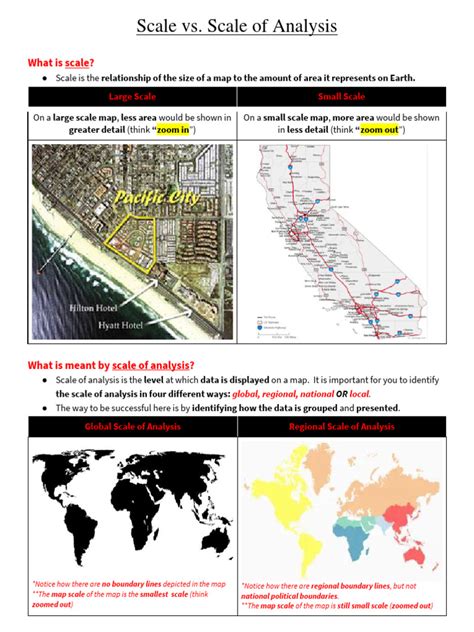
The concept of scale of analysis has numerous applications across various fields. In urban planning, for example, the macro scale involves the study of cities and metropolitan areas, while the micro scale focuses on individual buildings and neighborhoods. In public health, the meso scale examines the relationships between health outcomes and social determinants, such as income, education, and environment. The scale of analysis can inform policy decisions, interventions, and evaluations, ensuring that they are effective and targeted at the appropriate level.
Key Points
- The scale of analysis determines the level of detail and scope of a study.
- A suitable scale of analysis can help researchers identify patterns, relationships, and trends.
- The micro scale focuses on small units, the meso scale on intermediate units, and the macro scale on large units.
- A multiscale approach can provide a more comprehensive understanding of complex systems and phenomena.
- The choice of scale of analysis depends on the research question, data availability, and theoretical framework.
Challenges and Limitations
The scale of analysis can be challenging to determine, particularly in complex systems with multiple interacting components. The choice of scale can be influenced by factors such as data availability, theoretical frameworks, and research questions. Additionally, the scale of analysis can be limited by the level of detail and the scope of the study, which can neglect important aspects of the system. To overcome these challenges, researchers can use multiscale approaches, which combine insights from different scales, and engage in interdisciplinary collaborations to leverage expertise and knowledge from multiple fields.
In conclusion, the scale of analysis is a critical concept in research, as it determines the level of detail and the scope of a study. By understanding the importance of scale of analysis and its applications, researchers can design more effective studies, develop more accurate theories, and inform policy decisions and interventions. The scale of analysis can be applied to various fields, from physics to sociology, and can provide insights into complex systems and phenomena.
What is the importance of scale of analysis in research?
+The scale of analysis is essential in research because it determines the level of detail and the scope of the study. A suitable scale of analysis can help researchers to identify patterns, relationships, and trends that may not be apparent at other scales.
How does the scale of analysis affect the choice of research methods?
+The scale of analysis can influence the choice of research methods, as different scales require different approaches and techniques. For example, the micro scale may require experimental or observational methods, while the macro scale may involve statistical analysis or simulation modeling.
Can the scale of analysis be applied to multiple fields?
+Yes, the scale of analysis can be applied to various fields, from physics to sociology. The concept of scale is universal and can be used to study complex systems and phenomena in different disciplines.