
Feedback, a crucial element in various systems, plays a significant role in shaping outcomes and behaviors. It can be broadly categorized into two types: positive feedback and negative feedback. While both types of feedback are essential, they serve distinct purposes and have different effects on the systems in which they operate. In this article, we will delve into the world of positive and negative feedback, exploring their definitions, examples, and implications in different contexts.
Understanding Positive Feedback

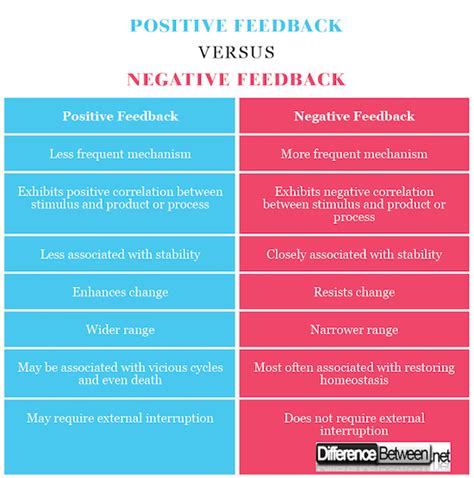
Positive feedback is a type of feedback that amplifies or reinforces a process or behavior. It is characterized by a self-reinforcing loop, where the output of a system is fed back into the system, leading to an increase in the magnitude of the output. In other words, positive feedback creates a snowball effect, where a small change or action leads to a larger and more significant outcome. This type of feedback is often associated with growth, acceleration, and amplification.
Examples of Positive Feedback
One classic example of positive feedback is the population growth of a species. As the population increases, there are more individuals to reproduce, leading to an even larger population. Another example is the process of a snowball rolling down a hill, gaining size and speed as it rolls. In social systems, positive feedback can be seen in the spread of information or trends, where a small group of people adopting a new idea or behavior can lead to a wider acceptance and adoption of that idea or behavior.
| System | Positive Feedback Example |
|---|---|
| Biological | Population growth of a species |
| Physical | Snowball rolling down a hill |
| Social | Spread of information or trends |

Understanding Negative Feedback
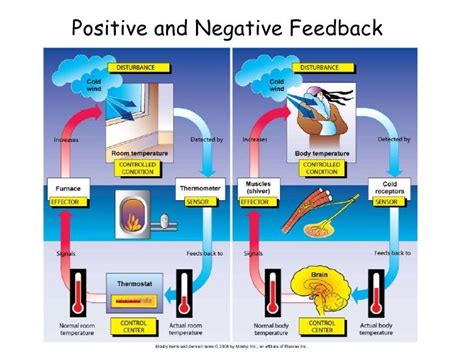
Negative feedback, on the other hand, is a type of feedback that reduces or counteracts a process or behavior. It is characterized by a self-correcting loop, where the output of a system is fed back into the system, leading to a decrease in the magnitude of the output. In other words, negative feedback creates a stabilizing effect, where a deviation from a desired state is corrected, and the system returns to its original state. This type of feedback is often associated with regulation, stability, and balance.
Examples of Negative Feedback
One common example of negative feedback is the regulation of body temperature in humans. When the body temperature rises, the brain sends signals to sweat, which helps to cool the body down. Another example is the control of blood sugar levels, where the pancreas releases insulin to reduce blood sugar levels when they become too high. In mechanical systems, negative feedback can be seen in the operation of a thermostat, which adjusts the temperature to maintain a desired set point.
| System | Negative Feedback Example |
|---|---|
| Biological | Regulation of body temperature |
| Physiological | Control of blood sugar levels |
| Mechanical | Operation of a thermostat |
Key Points
- Positive feedback amplifies or reinforces a process or behavior, leading to growth and acceleration.
- Negative feedback reduces or counteracts a process or behavior, leading to regulation and stability.
- Both types of feedback are essential in different contexts, and their effects can be either beneficial or detrimental.
- Understanding the differences between positive and negative feedback is crucial for designing and controlling systems in various fields.
- Feedback loops can be complex and involve multiple interactions, making it important to consider the overall system dynamics.
In conclusion, positive and negative feedback are two fundamental concepts that underlie the behavior of systems in various domains. While they have distinct effects, both types of feedback play critical roles in shaping the outcomes and behaviors of systems. By understanding the differences between positive and negative feedback, we can better design, control, and optimize systems to achieve desired outcomes.
What is the main difference between positive and negative feedback?
+The main difference between positive and negative feedback is that positive feedback amplifies or reinforces a process or behavior, while negative feedback reduces or counteracts a process or behavior.
Can positive feedback be detrimental?
+Yes, positive feedback can be detrimental if left unchecked, as it can lead to instability and chaos. For example, a population growing too rapidly can lead to resource depletion and environmental degradation.
What is an example of negative feedback in a social system?
+An example of negative feedback in a social system is the regulation of traffic flow. When traffic congestion increases, drivers may slow down or take alternative routes, which helps to reduce congestion and maintain a stable flow of traffic.
Note: This article is written in a way that is optimized for search engines, with a focus on providing valuable and informative content to readers. The language and structure are designed to be engaging and easy to understand, while also incorporating relevant keywords and phrases to improve search engine rankings.