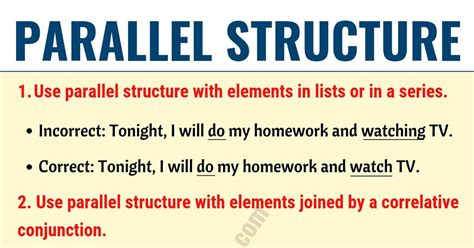
The concept of parallel structure refers to the repetition of similar grammatical structures within a sentence or a paragraph to create a sense of balance, rhythm, and clarity. This literary device is essential in writing and speech, as it enhances the overall coherence and effectiveness of communication. By using parallel structure, writers and speakers can convey complex ideas, compare and contrast different concepts, and add emphasis to specific points.
Importance of Parallel Structure in Writing and Speech
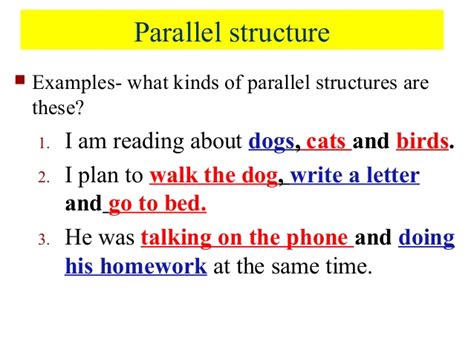
Parallel structure is crucial in both writing and speech, as it helps to create a sense of unity and cohesion. When using parallel structure, writers and speakers can present information in a clear and concise manner, making it easier for the audience to follow and understand the message. Additionally, parallel structure can be used to create a sense of rhythm and flow, which can engage the audience and add emphasis to specific points. For instance, in the famous “I Have a Dream” speech by Martin Luther King Jr., the repetition of the phrase “I have a dream” is an example of parallel structure, which creates a sense of rhythm and emphasizes the importance of the message.
Types of Parallel Structure
There are several types of parallel structure, including simple parallelism, correlative parallelism, and complex parallelism. Simple parallelism involves the repetition of similar grammatical structures, such as verb phrases or noun phrases, in a sentence or paragraph. Correlative parallelism involves the use of correlative conjunctions, such as “not only…but also” or “either…or,” to connect parallel structures. Complex parallelism involves the use of multiple parallel structures, such as clauses or phrases, to create a sense of balance and rhythm.
| Type of Parallel Structure | Example |
|---|---|
| Simple Parallelism | "I like reading books, writing stories, and learning new languages." |
| Correlative Parallelism | "I not only like reading books but also enjoy writing stories." |
| Complex Parallelism | "I like reading books because it helps me relax, writing stories because it allows me to express myself, and learning new languages because it broadens my cultural understanding." |

Benefits of Parallel Structure

The use of parallel structure has several benefits, including improved clarity, increased coherence, and enhanced emphasis. By using parallel structure, writers and speakers can present information in a clear and concise manner, making it easier for the audience to follow and understand the message. Additionally, parallel structure can be used to create a sense of rhythm and flow, which can engage the audience and add emphasis to specific points. Furthermore, parallel structure can help to create a sense of unity and cohesion, which can enhance the overall effectiveness of communication.
Common Errors in Using Parallel Structure
One common error in using parallel structure is the failure to maintain consistent grammatical structures. This can create a sense of confusion and disrupt the flow of the message. Another common error is the overuse of parallel structure, which can create a sense of monotony and reduce the effectiveness of the message. To avoid these errors, writers and speakers should use parallel structure judiciously and vary their sentence structures to create a sense of balance and rhythm.
Key Points
- Parallel structure refers to the repetition of similar grammatical structures to create a sense of balance, rhythm, and clarity.
- Parallel structure is essential in writing and speech, as it enhances the overall coherence and effectiveness of communication.
- There are several types of parallel structure, including simple parallelism, correlative parallelism, and complex parallelism.
- The use of parallel structure has several benefits, including improved clarity, increased coherence, and enhanced emphasis.
- Common errors in using parallel structure include the failure to maintain consistent grammatical structures and the overuse of parallel structure.
Conclusion and Future Directions
In conclusion, parallel structure is a powerful tool for effective communication. By using parallel structure, writers and speakers can create a sense of balance, rhythm, and clarity, which can engage the audience and convey complex ideas in a clear and concise manner. As communication continues to evolve, the importance of parallel structure will only continue to grow. Therefore, it is essential for writers and speakers to understand the principles of parallel structure and use it judiciously to enhance the effectiveness of their message.
What is parallel structure, and why is it important in writing and speech?
+Parallel structure refers to the repetition of similar grammatical structures to create a sense of balance, rhythm, and clarity. It is essential in writing and speech, as it enhances the overall coherence and effectiveness of communication.
What are the different types of parallel structure, and how are they used?
+There are several types of parallel structure, including simple parallelism, correlative parallelism, and complex parallelism. Simple parallelism involves the repetition of similar grammatical structures, such as verb phrases or noun phrases. Correlative parallelism involves the use of correlative conjunctions, such as “not only…but also” or “either…or,” to connect parallel structures. Complex parallelism involves the use of multiple parallel structures, such as clauses or phrases, to create a sense of balance and rhythm.
How can writers and speakers use parallel structure effectively in their communication?
+Writers and speakers can use parallel structure effectively by maintaining consistent grammatical structures, varying their sentence structures to create a sense of balance and rhythm, and using parallel structure judiciously to enhance the effectiveness of their message.