
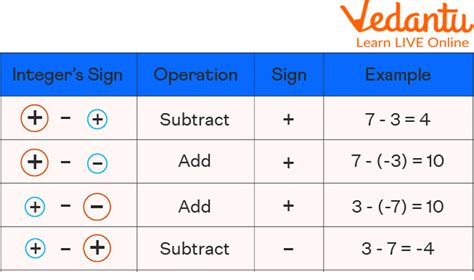
Understanding the concept of negative integers and their operations is crucial in mathematics, as it forms the foundation for more complex algebraic and arithmetic manipulations. One of the fundamental operations involving negative integers is subtraction. Subtraction of negative integers can seem counterintuitive at first, but with a clear understanding of the number line and the concept of additive inverses, it becomes more accessible. In this article, we will delve into the world of negative integers, explore how subtraction works with these numbers, and examine practical examples to solidify our understanding.
Key Points
- Negative integers are whole numbers less than zero, represented on the number line to the left of zero.
- Subtraction of negative integers involves understanding additive inverses and their role in arithmetic operations.
- The operation of subtracting a negative integer is equivalent to adding its positive counterpart.
- Practical applications of negative integers and their subtraction can be found in real-world scenarios such as finance, temperature changes, and directional movements.
- Mastery of subtracting negative integers is essential for advancing in mathematics and solving more complex problems.
Understanding Negative Integers

Negative integers are an integral part of the set of integers, which includes…, -3, -2, -1, 0, 1, 2, 3,…. These numbers are less than zero and are represented on the number line to the left of zero. The concept of negative integers is often introduced using real-world examples such as debts (where you owe money), temperatures below zero, or descending elevations. Each negative integer has a corresponding positive integer, known as its additive inverse, which when added together results in zero. For example, the additive inverse of -5 is 5, because -5 + 5 = 0.
Subtraction of Negative Integers
Subtracting a negative integer is mathematically equivalent to adding its positive counterpart. This principle stems from the definition of subtraction as the addition of the additive inverse. Thus, subtracting a negative number is the same as adding its positive counterpart. For instance, 3 - (-4) is equivalent to 3 + 4, which equals 7. This concept can be generalized to any pair of numbers. For example, if we have x - (-y), it is equivalent to x + y. Understanding this equivalence is crucial for simplifying expressions and solving equations involving negative integers.
| Operation | Equivalent Operation | Result |
|---|---|---|
| 5 - (-3) | 5 + 3 | 8 |
| -2 - (-4) | -2 + 4 | 2 |
| -1 - (-1) | -1 + 1 | 0 |

Practical Applications

Negative integers and their subtraction have numerous practical applications in various fields. In finance, for instance, a negative balance in an account indicates a debt. If a person has a debt of 100 and then borrows an additional 50, their new balance would be -150. This can be represented as -100 - 50, or, using the concept of subtracting a negative, if they were to "subtract" a debt of 50 (which is the same as adding $50), their balance would change from -100 to -50, represented as -100 - (-50) = -100 + 50 = -50. In temperature changes, if the temperature drops from -5°C to -8°C, this can be represented as -5 - 3, showing a decrease of 3 degrees Celsius.
Conclusion and Future Directions
Subtracting negative integers is a fundamental concept in mathematics that, once understood, opens the door to more complex mathematical operations and problem-solving. By grasping the equivalence between subtracting a negative and adding a positive, individuals can navigate through arithmetic operations with greater ease and confidence. As one progresses in their mathematical journey, the importance of mastering such basic yet powerful concepts becomes increasingly evident, laying the groundwork for algebra, calculus, and other advanced mathematical disciplines.
What is the rule for subtracting a negative integer?
+The rule for subtracting a negative integer is that it is equivalent to adding its positive counterpart. For example, x - (-y) = x + y.
How do negative integers relate to real-world scenarios?
+Negative integers can represent debts, temperatures below zero, or movements in a negative direction. They are essential for modeling and solving problems in finance, physics, and other fields.
Why is mastering the subtraction of negative integers important?
+Mastering the subtraction of negative integers is crucial because it provides a foundation for understanding more complex mathematical concepts and solving problems in various disciplines. It enhances mathematical literacy and problem-solving skills.