
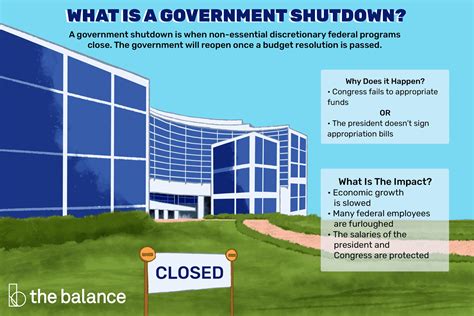
A government shutdown is a rare but significant event that occurs when the federal government of a country, in this case, the United States, fails to pass legislation funding its operations. This event has far-reaching consequences, impacting various sectors and affecting the daily lives of citizens. Understanding the mechanics of a government shutdown is crucial to grasp the potential ramifications and explore potential solutions.
The Mechanics of a Government Shutdown

A government shutdown is triggered when Congress fails to approve and the President fails to sign into law the necessary appropriations bills or continuing resolutions that provide funding for federal agencies and programs. These funding measures are crucial as they authorize the government to spend money on a wide range of services and operations, from national parks to scientific research, military operations, and social security payments.
In the United States, the federal government operates on a fiscal year basis, which runs from October 1st to September 30th of the following year. If Congress and the President cannot agree on a funding bill before the start of the new fiscal year, a continuing resolution is often passed to temporarily fund the government until a longer-term solution is reached. However, if this resolution is not enacted, or if it expires without a new funding bill in place, a shutdown ensues.
During a shutdown, non-essential federal government operations are typically halted. This means that many federal employees are placed on furlough, a temporary leave of absence without pay. Essential services, such as national security, air traffic control, and certain emergency services, continue to operate, but with reduced staffing levels. Other services, like national parks, museums, and government-funded research facilities, may be completely closed to the public.
Impact on Federal Employees
The human cost of a government shutdown is often significant. Federal employees, who provide vital services to the nation, face an uncertain future during a shutdown. While some are considered essential and continue to work without pay, others are furloughed and must wait for the shutdown to end before they can return to their jobs and receive their back pay.
The emotional and financial toll on these employees can be immense. Many face difficult decisions, such as delaying necessary expenses, taking on additional work to make ends meet, or even considering alternative career paths. The stress and uncertainty of a government shutdown can have long-lasting effects on the mental health and well-being of federal employees and their families.
Economic and Social Consequences
The economic impact of a government shutdown is far-reaching. According to a report by the Congressional Budget Office, the most recent shutdown in 2018-2019 cost the economy approximately $11 billion, with a significant portion of that loss being permanent. This loss is attributed to the disruption of government services, reduced economic activity, and the financial strain on federal employees and contractors.
Beyond the economic impact, a government shutdown can have severe social consequences. Delays in processing social security benefits, veteran services, and federal loans can cause significant hardship for those relying on these services. Furthermore, the closure of national parks and other federal facilities can disrupt local economies heavily dependent on tourism and recreational activities.
Previous Shutdowns and Lessons Learned
The United States has experienced several government shutdowns in recent decades, each with its own unique circumstances and outcomes. The 2018-2019 shutdown, which lasted 35 days, was the longest in history and resulted in a significant backlash against political leaders. This shutdown highlighted the need for improved communication, collaboration, and compromise between political parties to avoid such disruptive events.
One of the key lessons learned from past shutdowns is the importance of contingency planning. Federal agencies now have more robust plans in place to ensure essential services continue and to minimize the impact on the public. Additionally, there has been a greater emphasis on resolving funding disputes through bipartisan negotiations and compromise, rather than through the extreme measure of a shutdown.
| Shutdown Period | Duration | Cause |
|---|---|---|
| October 1-16, 2013 | 16 days | Dispute over Obamacare funding |
| December 22, 2018 - January 25, 2019 | 35 days | Dispute over border wall funding |
| January 10-19, 1996 | 10 days | Budget dispute between President Clinton and Congress |

Avoiding and Resolving Shutdowns

Preventing government shutdowns requires a proactive approach and a willingness to engage in bipartisan negotiations. Here are some strategies to mitigate the risk of shutdowns and their impact:
- Early Budget Planning: Starting the budget process earlier in the year can help prevent last-minute crises. This allows for more time to negotiate and resolve funding disputes.
- Bipartisan Collaboration: Political parties should prioritize compromise and work together to find common ground on funding issues. This may involve seeking input from experts and stakeholders outside of politics.
- Enhanced Contingency Planning: Federal agencies should continue to refine their contingency plans to ensure essential services can continue during a shutdown. This includes identifying critical functions and allocating resources accordingly.
- Public Education: Educating the public about the potential impacts of a government shutdown can help build support for timely budget resolutions. Informed citizens can play a crucial role in pressuring political leaders to avoid shutdowns.
The Role of the President
The President plays a crucial role in resolving funding disputes and preventing government shutdowns. While the President cannot single-handedly pass funding bills, they can use their influence to bring political parties together and encourage compromise. Additionally, the President can work with federal agencies to ensure essential services continue during a shutdown and to minimize the impact on the public.
Potential Solutions and Reforms
To further reduce the likelihood of government shutdowns, some experts propose reforms to the budget process. These may include:
- Automatic Continuing Resolutions: Implementing a system where continuing resolutions are automatically enacted if a funding bill is not passed by a certain date could prevent shutdowns from occurring.
- Line-Item Veto: Granting the President the power to veto specific line items in a funding bill, rather than the entire bill, could allow for more targeted budget negotiations.
- Bi-annual Budgeting: Shifting to a bi-annual budget process, where budgets are approved for two years at a time, could provide more stability and reduce the frequency of funding crises.
Conclusion
Government shutdowns are complex events with significant consequences for the nation. They highlight the challenges of balancing political ideologies with the practical needs of governing. By understanding the mechanics of shutdowns and exploring potential solutions, we can work towards a more stable and efficient government, ensuring the delivery of vital services to the American people.
What is the impact of a government shutdown on the economy and society?
+
A government shutdown can have significant economic and social consequences. It disrupts government services, reduces economic activity, and places financial strain on federal employees and contractors. Social services may be delayed, and industries reliant on federal funding or services may suffer.
How often do government shutdowns occur in the United States?
+
Government shutdowns in the United States are relatively rare, but they have occurred several times in recent decades. The frequency and duration of shutdowns vary, with some lasting only a few days and others extending for weeks.
What services are typically impacted during a government shutdown?
+
During a government shutdown, non-essential federal services are typically impacted. This can include national parks, museums, government-funded research facilities, and certain administrative services. Essential services, such as national security, air traffic control, and emergency response, continue to operate.