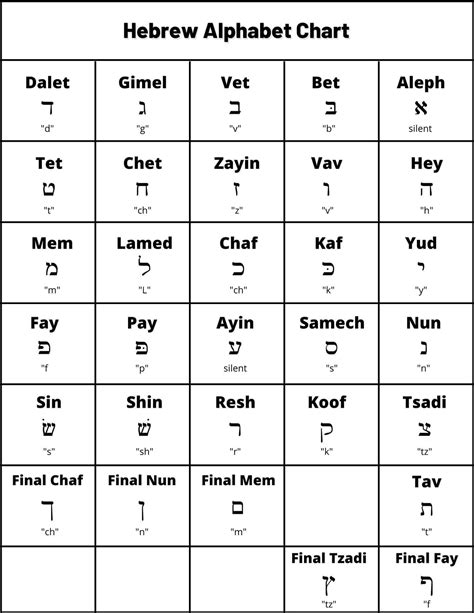
The Hebrew alphabet, also known as the Aleph-Bet, is a fundamental component of the Hebrew language and has significant cultural and historical importance. Consisting of 22 letters, all of which are consonants, the Hebrew alphabet is written from right to left. Understanding the Hebrew alphabet is crucial for reading and writing in Hebrew, as well as for appreciating the language's rich heritage and biblical significance.
Introduction to the Hebrew Alphabet

The Hebrew alphabet has undergone several transformations over the centuries, with its earliest forms dating back to ancient times. The modern Hebrew alphabet used today is based on the Assyrian script, which was adopted during the Babylonian exile. Each letter in the Hebrew alphabet has a unique name, and some letters have distinct meanings or symbolism associated with them. For example, the first letter “Aleph” represents the number 1 and symbolizes the beginning or unity, while the last letter “Tav” represents the number 400 and symbolizes completion or perfection.
Hebrew Alphabet Chart
A Hebrew alphabet chart is a valuable tool for learning the Hebrew language, as it provides a visual representation of all the letters. The chart typically includes the letter’s name, its pronunciation, and sometimes its numerical value, as each letter in the Hebrew alphabet corresponds to a specific number. This numerical system, known as Gematria, is used for various purposes, including biblical interpretation and coding. Here is a basic outline of what a Hebrew alphabet chart might look like:
| Letter | Name | Pronunciation | Numerical Value |
|---|---|---|---|
| א | Aleph | /ʔ/, silent | 1 |
| ב | Bet/Vet | /b/, /və/ | 2 |
| ג | Gimel | /ɡ/ | 3 |
| ד | Dalet | /d/ | 4 |
| ה | He | /h/ | 5 |
| ו | Vav | /v/ | 6 |
| ז | Zayin | /z/ | 7 |
| ח | Chet | /χ/ | 8 |
| ט | Tet | /t/ | 9 |
| י | Yud | /j/ | 10 |
| כ/ך | Kaf/Chaf | /k/, /χ/ | 20 |
| ל | Lamed | /l/ | 30 |
| מ/ם | Mem | /m/ | 40 |
| נ/ן | Nun | /n/ | 50 |
| ס | Samech | /s/ | 60 |
| ע | Ayin | /ʔ/, silent | 70 |
| פ/ף | Pe/Fe | /p/, /f/ | 80 |
| צ/ץ | Tsadi | /ts/ | 90 |
| ק | Kuf | /k/ | 100 |
| ר | Resh | /r/ | 200 |
| ש | Shin/Sin | /ʃ/, /s/ | 300 |
| ת | Tav | /t/ | 400 |

Key Points
- The Hebrew alphabet consists of 22 consonantal letters, all of which are written from right to left.
- Each letter has a unique name and pronunciation, with some letters having distinct numerical values and symbolic meanings.
- A Hebrew alphabet chart is a useful tool for learning the language, providing a comprehensive overview of the letters, their names, pronunciations, and numerical values.
- Understanding the Hebrew alphabet is crucial for reading and writing in Hebrew, as well as for appreciating the language's cultural and historical significance.
- The study of the Hebrew alphabet is interdisciplinary, involving linguistics, history, culture, and biblical studies.
Learning the Hebrew Alphabet

Learning the Hebrew alphabet requires dedication and practice, but it can also be a rewarding experience for those interested in languages, culture, and biblical studies. There are several approaches to learning the Hebrew alphabet, including using flashcards, practicing writing, and listening to pronunciation guides. It’s also helpful to learn the alphabet in the context of words and phrases, rather than just as individual letters. For those interested in deeper study, there are numerous resources available, including textbooks, online courses, and language learning apps.
Hebrew Alphabet in Biblical Context
The Hebrew alphabet plays a central role in biblical studies, as the Hebrew Bible (Tanakh) is written primarily in Hebrew. Understanding the Hebrew alphabet is essential for reading and interpreting biblical texts in their original language. The use of the Hebrew alphabet in biblical manuscripts and inscriptions provides valuable insights into the history and development of the Hebrew language, as well as the cultural and religious practices of ancient Israel. Furthermore, the study of the Hebrew alphabet in biblical context can enhance one’s understanding of biblical themes, motifs, and symbolism.
What is the significance of the Hebrew alphabet in Jewish tradition?
+The Hebrew alphabet holds profound significance in Jewish tradition, as it is the script used to write the Hebrew Bible and other sacred texts. Each letter is believed to have spiritual significance and is used in various rituals and prayers. The study of the Hebrew alphabet is also considered a way to connect with Jewish heritage and cultural identity.
How does one pronounce the Hebrew letters correctly?
+Pronouncing Hebrew letters correctly requires practice and a good understanding of the Hebrew pronunciation system. It's helpful to listen to native speakers and use pronunciation guides. Some letters, like Aleph and Ayin, are pronounced as glottal stops or are silent, while others have distinct sounds, such as the "ch" in Chet, which is a guttural sound.
What resources are available for learning the Hebrew alphabet?
+There are numerous resources available for learning the Hebrew alphabet, including textbooks, online courses, language learning apps, and video tutorials. Many synagogues and Jewish community centers also offer Hebrew classes. For those interested in biblical studies, there are specialized courses and resources that focus on the Hebrew alphabet in a biblical context.
In conclusion, the Hebrew alphabet is a fascinating subject that offers insights into language, culture, and history. Whether one is interested in learning Hebrew for practical purposes or for deeper cultural and biblical understanding, studying the Hebrew alphabet is a rewarding journey. With its unique characteristics, rich symbolism, and central role in Jewish tradition and biblical studies, the Hebrew alphabet continues to captivate scholars and learners alike, inviting exploration and discovery.