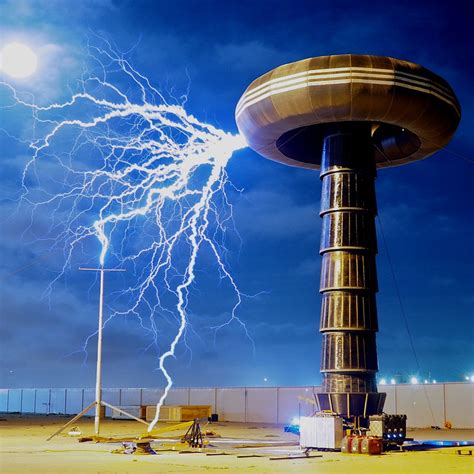
The fascination with giant Tesla coils and their ability to produce massive, electrifying displays of energy has captivated audiences for decades. Named after the ingenious inventor Nikola Tesla, these coils are a testament to the power of electrical engineering and the innovative spirit of their creator. At the heart of a Tesla coil lies a fundamental principle: the production of high-voltage, low-current electricity through resonance and electromagnetic induction. This concept, while seemingly complex, forms the basis of many modern technologies, from radio transmitters to medical equipment.
Understanding the Basics of Tesla Coils

A Tesla coil consists of two main components: a primary coil and a secondary coil, each connected to a capacitor. The primary coil is where the electrical current from a power source, such as a transformer, is introduced. This current flows through the primary coil, generating a magnetic field. As the current oscillates, it induces an electromagnetic field in the secondary coil, which has a much larger number of turns than the primary coil. The secondary coil, being loosely coupled to the primary coil, experiences a significant increase in voltage due to the principle of electromagnetic induction, leading to the production of extremely high voltages.
How Tesla Coils Produce Giant Sparks
The process of producing giant sparks from a Tesla coil involves several key steps. Initially, the primary coil is energized, creating a magnetic field that induces a voltage in the secondary coil. As the voltage in the secondary coil builds up, it eventually exceeds the breakdown voltage of the air around the coil, resulting in a spark or arc. This spark can reach lengths of several meters, depending on the design and power of the Tesla coil. The combination of high voltage and the unique design of the coil allows for the creation of these spectacular electrical discharges.
| Component | Description | Role in Tesla Coil Operation |
|---|---|---|
| Primary Coil | Carries the initial electrical current | Generates the magnetic field that induces voltage in the secondary coil |
| Secondary Coil | Has a larger number of turns than the primary coil | Increases the voltage through electromagnetic induction |
| Capacitor | Stores electrical energy | Plays a crucial role in the resonant circuit, enabling the coil to achieve high voltages |

Applications and Safety Considerations of Giant Tesla Coils

While Tesla coils are often associated with entertainment and educational demonstrations, their technology has influenced various fields, including radio communication, medical devices, and even some types of lighting. However, the operation of giant Tesla coils poses significant safety risks, including the potential for electrical shock, fire, and damage to surrounding equipment. Therefore, it is crucial that all experiments and demonstrations with Tesla coils are conducted with proper safety precautions and under the supervision of experienced professionals.
Evolution and Innovations in Tesla Coil Technology
Over the years, the design and construction of Tesla coils have evolved significantly, with advancements in materials and technology allowing for more efficient and safer operation. Innovations such as solid-state Tesla coils, which use transistors instead of spark gaps to switch the current, have improved the reliability and control of these devices. Additionally, the development of safety features and better insulation materials has reduced the risks associated with their operation.
Key Points
- Tesla coils operate on the principle of electromagnetic induction to produce high-voltage, low-current electricity.
- The primary and secondary coils, along with a capacitor, form the core components of a Tesla coil.
- Giant sparks are produced when the voltage in the secondary coil exceeds the breakdown voltage of the surrounding air.
- Safety considerations are paramount due to the high-voltage nature of Tesla coils.
- Applications of Tesla coil technology can be found in various fields, including communications and medicine.
In conclusion, giant Tesla coils represent a captivating intersection of electrical engineering, physics, and innovation. Their ability to produce spectacular displays of electricity has not only entertained but also educated generations about the fundamental principles of electromagnetism. As technology continues to evolve, it will be interesting to see how the concepts pioneered by Nikola Tesla are applied in new and innovative ways, contributing to advancements in science and engineering.
What is the primary principle behind the operation of a Tesla coil?
+The primary principle is electromagnetic induction, where a changing magnetic field in the primary coil induces a voltage in the secondary coil, leading to the generation of high-voltage electricity.
What are some safety precautions to consider when working with Tesla coils?
+Safety precautions include ensuring proper insulation, using protective gear such as gloves and safety glasses, and maintaining a safe distance from the coil during operation to avoid electrical shock.
What are some potential applications of Tesla coil technology?
+Potential applications include radio communication, medical devices, and certain types of lighting, showcasing the versatility of the technology developed by Nikola Tesla.