
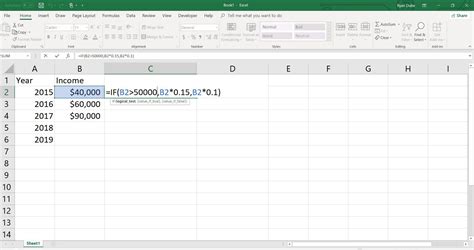
Welcome to this comprehensive guide on the Excel IF THEN function, a powerful tool for automating decision-making processes within your spreadsheets. The IF THEN function, often simply referred to as the IF function, is a fundamental feature in Excel that allows you to perform different calculations or actions based on whether a specified condition is TRUE or FALSE. This function is particularly useful for creating dynamic and interactive spreadsheets, as it enables you to automate tasks, perform conditional formatting, and generate dynamic reports.
In this article, we will delve into the intricacies of the IF THEN function, exploring its syntax, practical examples, and advanced applications. By the end of this guide, you'll be equipped with the knowledge and skills to harness the full potential of this versatile Excel function.
Understanding the IF THEN Function

The IF THEN function in Excel is a logical function that allows you to specify a condition and define the actions to be taken based on whether that condition is met. This function follows a simple syntax, making it accessible to users of all skill levels.
Syntax
The syntax of the IF function is as follows:
=IF(logical_test, value_if_true, value_if_false)
- logical_test: This is the condition that you want to evaluate. It can be a comparison between two values, a reference to a cell containing data, or a formula that returns a TRUE or FALSE result.
- value_if_true: This is the value or formula that will be returned if the logical_test evaluates to TRUE.
- value_if_false: This is the value or formula that will be returned if the logical_test evaluates to FALSE.
Example
Let's consider a simple example to illustrate how the IF function works. Imagine you have a spreadsheet containing a list of students' test scores, and you want to determine whether each student has passed or failed based on a passing score of 60.
| Student | Test Score | Result |
|---|---|---|
| Alice | =IF(B2>=60,"Pass","Fail") | |
| Bob | =IF(B3>=60,"Pass","Fail") | |
| ... | ... | ... |

In the above example, the IF function is used to compare the test score in column B with the passing score of 60. If the test score is greater than or equal to 60, the function returns "Pass"; otherwise, it returns "Fail". The result is displayed in the corresponding cell in column C.
Advanced Applications of the IF THEN Function

While the basic IF function is powerful on its own, Excel offers several advanced applications and techniques that can further enhance your spreadsheet capabilities.
Nested IF Functions
One of the most common advanced techniques is nesting IF functions within each other. This allows you to evaluate multiple conditions and perform more complex decision-making processes. By nesting IF functions, you can create a cascading effect, where each subsequent IF statement is evaluated based on the result of the previous one.
For example, you can use nested IF functions to determine grade levels based on test scores. If the score is greater than or equal to 90, it's an A; if it's between 80 and 89, it's a B; and so on.
| Test Score | Grade |
|---|---|
| =IF(B2>=90,"A",IF(B2>=80,"B",IF(B2>=70,"C","D"))) | |
| =IF(B3>=90,"A",IF(B3>=80,"B",IF(B3>=70,"C","D"))) | |
| ... | ... |
Combining IF with Other Functions
The IF function can be combined with other Excel functions to create even more powerful formulas. For instance, you can use the SUMIF function to calculate the sum of values that meet a certain condition. Similarly, the COUNTIF function can be used to count the number of cells that meet a specific criterion.
Using IF for Conditional Formatting
The IF function is not limited to returning values; it can also be used for conditional formatting. By combining the IF function with the FORMAT function, you can apply specific formatting styles to cells based on the conditions you specify.
For example, you can format cells to display a green background if the value is greater than 50 and a red background if it's less than 50.
Best Practices and Tips
To make the most of the IF THEN function in Excel, consider the following best practices and tips:
- Keep your formulas simple and easy to understand. Complex nested IF functions can become difficult to manage and debug.
- Use cell references instead of hard-coding values whenever possible. This makes your formulas more dynamic and easier to update.
- Take advantage of the AND, OR, and NOT logical operators to create more flexible conditions.
- Consider using Excel's built-in data validation features to ensure that your data meets specific criteria before using it in IF functions.
- Utilize Excel's error handling functions, such as IFERROR, to handle potential errors gracefully.
Conclusion
The IF THEN function is a cornerstone of Excel's functionality, empowering users to automate decision-making processes and create dynamic spreadsheets. By understanding its syntax and advanced applications, you can unlock the full potential of this powerful tool. Whether you're a beginner or an experienced Excel user, mastering the IF function will undoubtedly enhance your spreadsheet skills and streamline your workflow.
FAQ

Can I use multiple conditions in an IF statement?
+
Yes, you can use multiple conditions in an IF statement by nesting IF functions. Each nested IF function evaluates a separate condition, and the result of the previous IF function is used as the logical_test for the next one.
How do I handle errors in IF functions?
+
To handle errors gracefully, you can use the IFERROR function. This function allows you to specify an alternative value or action to be taken if an error occurs in the IF function. For example: =IFERROR(IF(condition), “Error: Invalid Data”)
Can I use IF functions with arrays or ranges of cells?
+
Yes, you can use IF functions with arrays or ranges of cells. For example, you can use the SUMIF function to calculate the sum of values in a range that meet a certain condition. The syntax would be: =SUMIF(range, condition, sum_range)