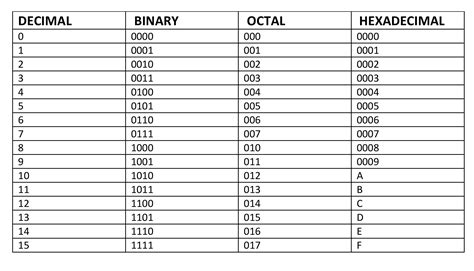
Understanding the relationship between decimal and hexadecimal number systems is crucial in the realm of computer science and programming. The decimal system, which is base 10, is the most commonly used number system in everyday life. However, computers operate on binary code, which is base 2, and hexadecimal, which is base 16, serves as a more human-friendly representation of binary. In this article, we will delve into the conversion process between decimal and hexadecimal, exploring the theoretical foundations, practical applications, and providing examples to solidify understanding.
Introduction to Decimal and Hexadecimal Systems

The decimal system uses 10 digits (0 through 9) to represent numbers. In contrast, the hexadecimal system uses 16 digits: the numbers 0-9 and the letters A-F, which represent the numbers 10-15, respectively. This base-16 system is particularly useful for computers because it can easily be converted to and from binary, which is the native language of computers.
Converting Decimal to Hexadecimal
To convert a decimal number to hexadecimal, one must divide the decimal number by 16 and keep track of the remainders. The process involves repeated division by 16 until the quotient becomes 0. The remainders, when read from bottom to top, give the hexadecimal representation. For example, converting the decimal number 123 to hexadecimal involves the following steps:
| Division Step | Quotient | Remainder |
|---|---|---|
| 123 / 16 | 7 | 11 (B in hexadecimal) |
| 7 / 16 | 0 | 7 |

Reading the remainders from the last to the first gives us 7B, which is the hexadecimal representation of 123 in decimal.
Converting Hexadecimal to Decimal
The conversion from hexadecimal to decimal is more straightforward. Each hexadecimal digit is multiplied by 16 raised to the power of its position, counting from right to left and starting with 0. The results are then added together. For the hexadecimal number 7B, the conversion would be:
7 * 16^1 + 11 * 16^0 = 7 * 16 + 11 * 1 = 112 + 11 = 123
Key Points
- The decimal system is base 10, while the hexadecimal system is base 16.
- Hexadecimal numbers use digits 0-9 and letters A-F to represent numbers 10-15.
- Conversion from decimal to hexadecimal involves repeated division by 16 and tracking remainders.
- Conversion from hexadecimal to decimal involves multiplying each digit by 16 raised to the power of its position and summing the results.
- Understanding decimal and hexadecimal conversions is fundamental for programming and computer science.
Practical Applications and Implications

The ability to convert between decimal and hexadecimal is not only a theoretical exercise but has practical implications in programming, web development, and data analysis. In web design, for instance, colors are often represented in hexadecimal format to define their RGB values. In programming, understanding how to work with hexadecimal can be crucial for tasks such as debugging, where hexadecimal representations of memory addresses are used.
Furthermore, in the realm of cybersecurity, hexadecimal is used to represent binary data in a more readable format, making it easier to analyze and understand malware, vulnerabilities, and other security threats. The conversion between decimal and hexadecimal, therefore, is a foundational skill that underpins many aspects of the digital world.
Educational and Professional Perspectives
From an educational standpoint, teaching decimal and hexadecimal conversions early in computer science curricula lays a strong foundation for future learning. It introduces students to the concept of different number systems and how they are used in computing, preparing them for more advanced topics such as binary arithmetic and computer architecture.
Professionally, the ability to work with and convert between these number systems efficiently is a valuable skill. It demonstrates a deep understanding of the underlying principles of computer science and can be a differentiator in the job market. Employers in the tech industry often look for candidates who can not only write code but also understand the theoretical foundations upon which programming languages are built.
Why is hexadecimal used in computing instead of just binary?
+Hexadecimal is used because it provides a more compact and readable representation of binary data. Since one hexadecimal digit can represent four binary digits (bits), it simplifies the process of reading, writing, and analyzing binary code.
How is hexadecimal used in web development?
+In web development, hexadecimal is primarily used to define colors in CSS and to represent binary data in a more readable format. For colors, each hexadecimal value represents the red, green, and blue (RGB) components of the color, allowing for precise color specification.
What is the significance of understanding decimal and hexadecimal conversions in cybersecurity?
+Understanding decimal and hexadecimal conversions is crucial in cybersecurity for analyzing and understanding binary data, such as malware and vulnerabilities. It allows security professionals to read and interpret binary code in a more manageable format, facilitating the identification and mitigation of security threats.
In conclusion, the conversion between decimal and hexadecimal number systems is a fundamental concept in computer science, with far-reaching implications for programming, web development, and cybersecurity. As the digital landscape continues to evolve, the importance of understanding these conversions will only increase, making it an essential skill for professionals and students alike in the tech industry.